A ten-percent move in gold does not have the same dollar significance for every owner. It depends on how much fine gold the collection actually contains and how closely its resale value follows the metal market. A worked example can help make that exposure understandable. The key is to keep the assumptions visible rather than presenting a model as an appraisal.
Define the collection before doing the calculation
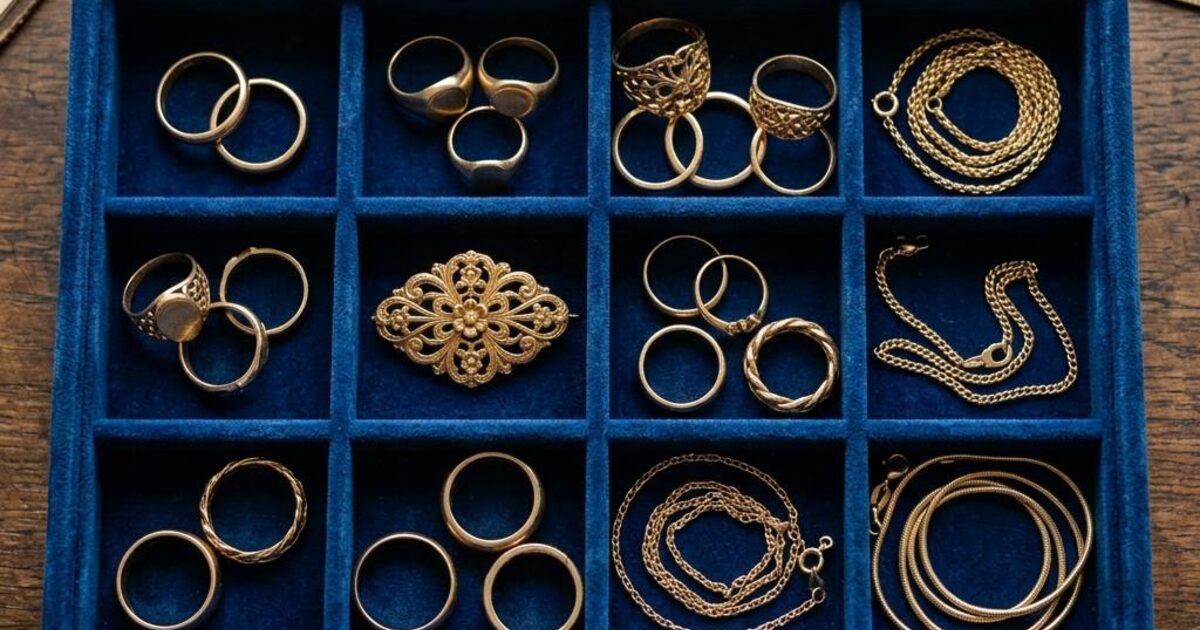
Assume a hypothetical collection contains 50 grams of net gold-bearing alloy at a verified fineness of 585, or 58.5% gold. That means it contains 29.25 grams of fine gold. The example excludes stones, steel components, and any non-gold material before the 50-gram figure is used. It also assumes no designer or collectible premium.
Apply the dated market reference
At the Reuters spot snapshot of $4,026.15 per troy ounce at 09:36 GMT on October 23, 2026, that fine-gold content has an illustrative theoretical metal value of approximately $3,786.23. The calculation is 50 grams multiplied by 0.585, divided by 31.1034768 grams per troy ounce, multiplied by $4,026.15. It is not a purchase offer.
- If spot were 10% higher with everything else unchanged, the modeled metal value would be about $4,164.85.
- If spot were 10% lower, the modeled metal value would be about $3,407.61.
- The modeled difference from the starting point would be about $378.62 in either direction.
Why the real-world result may differ
Actual offers depend on recovery costs, buying terms, testing, and whether the items can be resold rather than refined. Those terms may not remain identical while spot changes. A collection with mixed purities also needs separate calculations. Applying one average purity to every piece can produce a false sense of precision.
A signed bracelet or scarce coin introduces a further distinction: its non-metal value need not move by the same percentage as gold. Conversely, the retail cost of making an ordinary piece is not necessarily recovered on resale. Neither issue can be resolved by multiplying a headline percentage by an old purchase receipt.
Use sensitivity to clarify the decision
The exercise lets an owner compare a possible market move with the practical importance of selling now or later. It does not determine which decision is right. If the modeled change is small relative to the value of finding missing documentation or identifying an exceptional piece, that preparatory work may deserve attention before market timing.
Separate sentimental pieces first
Items you would regret selling should not be swept into a calculation simply because they contain gold. Decide what is genuinely available for evaluation, then test and weigh that group. A model becomes more useful when it describes the collection you are actually considering, not every piece you happen to own.
Editorial note — researched October 23, 2026. Dated market figures are snapshots, not a live feed or a purchase offer. Forward-looking scenarios are analysis, not guarantees or personalized investment advice. Check a fresh quote before making a decision.
An accurate inventory comes before an accurate estimate. Gold Buyers Connecticut can help evaluate mixed jewelry and identify pieces that may deserve treatment beyond a metal-only calculation.